A wet entryway can make a business look unprepared in about five seconds. It also creates a real maintenance and slip-resistance problem. That is why choosing the best mats for business entrances is less about decor and more about performance, safety, and how your facility actually operates day to day.
The right entrance mat needs to do three jobs well. It should stop dirt and moisture before they spread, hold up under steady foot traffic, and support the image you want visitors to see when they walk in. In some buildings, that means a hard-working scraper mat outside and a branded logo mat inside. In others, it means a more specialized combination built around weather exposure, floor type, and traffic volume.
Most entry mat problems start when buyers focus on appearance first and performance second. A mat may look sharp when it arrives, but if it slides, curls, saturates too quickly, or wears down under traffic, it stops doing its job fast.
A commercial entrance mat should trap grit before it scratches interior floors, absorb or channel water so it is not tracked deeper into the building, and stay flat under repeated use. For many organizations, there is also a branding requirement. A logo mat at the front door or reception area can make a stronger first impression than a blank mat, but only if the mat is built for commercial use and placed in the right location.
The best choice depends on where the mat will sit. Outdoor exposed entries need aggressive scraping action and materials that handle rain, debris, and temperature changes. Indoor vestibules need moisture retention and a professional appearance. Lobby areas often benefit from a higher-end surface that reinforces branding while still collecting leftover moisture and soil.
If you are comparing the best mats for business entrances, begin by looking at the full path people take into the building. Most entrances perform better with a system than with one oversized mat.
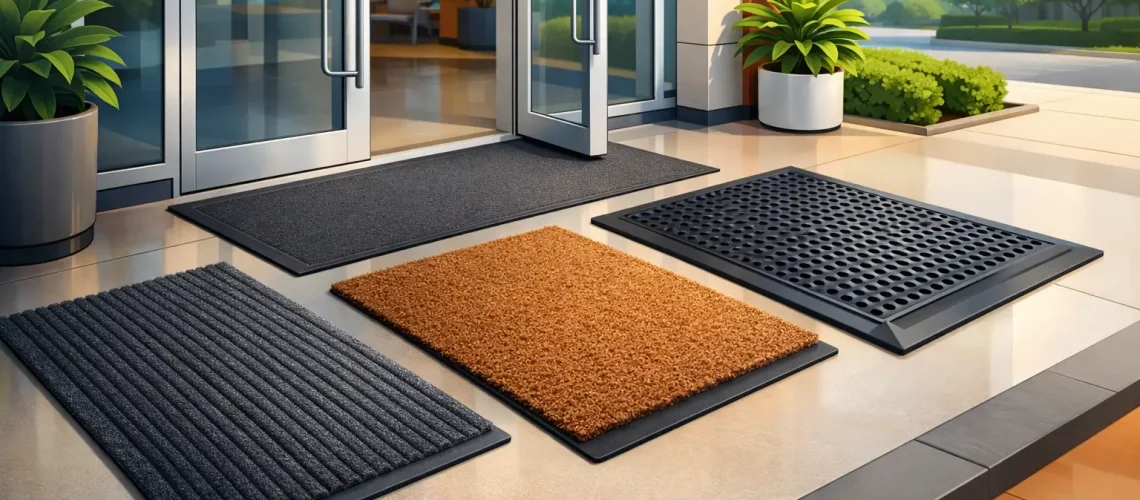
Outdoor mats are your first line of defense. Their main job is to scrape off larger debris, mud, and grit before it reaches your interior floors. Rubber scraper mats and heavy-duty molded designs work well here because they resist weather and stay functional even when conditions are rough.
The trade-off is appearance. Outdoor scraper mats are built for abuse, not detailed branding. If curb appeal matters at the front door, you may still want a cleaner-looking branded mat just inside the entrance where it is protected from direct exposure.
Vestibule mats do the hard work of moisture control. This is where absorbent, high-twist carpet surface mats and water-dam designs earn their value. They help stop rain, snow, and fine dirt that get past the first barrier.
In many commercial settings, this is the most important mat in the building. If your entry has no vestibule and opens directly into a lobby, the indoor mat needs to carry more of the load. That usually means choosing a product designed for serious water retention, not just a decorative surface.
Once visitors are fully inside, the mat has a slightly different role. It still needs to support cleanliness and safety, but it also becomes part of the presentation. Logo mats, inlay mats, and premium carpeted entrance mats are common here because they help businesses reinforce their brand while maintaining a polished, professional look.
This is often where custom mats make the most sense. A well-produced logo mat can make the front entrance feel more finished and intentional. It is also practical if it is placed after scraper and moisture-control mats have already removed the worst of the debris.
Material affects durability, cleaning, appearance, and cost. There is no single best material for every entrance, but there are clear strengths by application.
Rubber is a strong option for outdoor use and for areas where scraping action matters most. It handles weather well and tends to stay in place, but it does not absorb water the way a carpet-surface mat can.
Polypropylene and similar carpet fibers are widely used in indoor entrance mats because they resist staining, dry relatively quickly, and can hold both dirt and moisture effectively. These surfaces are often the best fit for vestibules, lobbies, and branded interior placements.
Nitrile rubber backing is worth paying attention to, especially in commercial facilities. It helps mats lie flatter, resist curling, and perform better under heavier use than lighter backings. For buyers who need long-term value, backing construction matters almost as much as the surface.
Vinyl loop mats can work in some applications, especially where drainage and basic debris collection are the priority, but they generally do not project the same polished image as higher-end logo or carpeted entry mats. They are functional, but not always the best choice for a main customer-facing entrance.
A small office with occasional visitors needs a different mat than a hospital entrance, school lobby, or apartment community leasing office. Traffic volume changes everything.
For light to moderate traffic, a good quality indoor logo mat or absorbent entry mat may be enough, especially if the entrance is covered. For high-traffic buildings, you want heavier construction, better backing, and more aggressive soil and moisture control. Mats in busy facilities wear out early when buyers choose based on price alone.
It also helps to think in terms of maintenance cost, not just purchase cost. A mat that lasts longer, protects flooring better, and reduces cleaning time can easily justify a higher upfront price. That is especially true in buildings with large hard-surface floors where tracked-in moisture and grit create constant upkeep.
Many organizations want the entrance mat to support branding. That is a smart use of space. A custom mat can make a lobby feel more professional, reinforce company identity, and create a cleaner visual transition into the building.
But the best branded mat is still a commercial floor mat first. Color clarity, logo detail, and presentation matter, but so do slip resistance, edge stability, and surface durability. If a mat looks great in a proof but fails under traffic, it becomes a poor branding tool very quickly.
That is why custom logo mats are usually best placed indoors or in covered areas unless the product is specifically built for outdoor exposure. Protected placement helps preserve appearance and extends usable life.
One of the most common mistakes is choosing a mat that is too small. If people can step over or around it in one stride, it will not capture enough soil or moisture to make much difference. A longer mat run often performs better than a wider decorative piece.
Another mistake is using one mat where two or three zones are needed. Outdoor scraping, indoor drying, and interior branding are different jobs. Trying to solve all three with a single product usually leads to compromise.
Buyers also underestimate cleaning. Even the best entrance mat needs regular vacuuming, extraction, hosing, or shake-out maintenance depending on the product type. A mat that fits your maintenance routine is usually a better investment than one with strong specs but unrealistic upkeep requirements.
Commercial buyers should ask straightforward questions. Is the mat intended for indoor, outdoor, or dual use? Is it built for high traffic? What kind of backing does it use? How are logo colors and details reproduced? What is the expected production timeline?
If you are ordering a custom product, proofing support matters too. A responsive supplier can help confirm sizing, artwork fit, and product selection before production starts. That reduces delays and helps avoid ordering a mat that looks good on screen but is wrong for the space.
For businesses that want a balance of branding, cleanliness, and durability, working with a specialist usually saves time. Companies such as LogoFloorMats.com focus on these product categories every day, which makes it easier to sort through options like WaterHog, Berber-style logo mats, scraper mats, and inlay products without guessing.
For most commercial facilities, the best answer is a layered approach. Use a durable scraper mat outside if the entrance is exposed, a moisture-control mat in the vestibule or just inside the door, and a branded logo mat in the lobby or reception area where appearance matters most.
If you only have room for one mat, choose based on your biggest problem. If weather and tracked-in water are the issue, prioritize absorbency and water retention. If curbside dirt and grit are constant, prioritize scraping action. If your entrance is already protected and you want to improve presentation, a high-quality logo mat may be the right move.
A business entrance mat is not a small detail. It affects safety, cleaning workload, floor protection, and the first impression visitors get before anyone says a word. Pick the mat for the way your building really works, and it will do more than cover the floor.