A wet entry can turn into a safety issue fast. It only takes a few people tracking in rain, dust, or debris before your lobby, hallway, or front office starts looking neglected. That is why commercial entrance mats matter so much. The right mat helps protect floors, cuts down on cleaning, improves traction, and gives visitors a more professional first impression the moment they walk in.
For most businesses and organizations, the challenge is not deciding whether to use mats. It is choosing the right type. A mat that looks good but saturates quickly will create problems. A mat built for scraping debris may not deliver the appearance you want for an interior lobby. And if branding matters, you need a product that can carry a logo clearly without giving up day-to-day performance.
Commercial entrance mats have a simple job on paper, but in practice they are asked to do several things at once. They need to remove water, capture dirt, reduce slip risk, and hold up under repeated foot traffic. In many facilities, they also need to support the overall look of the entrance, whether that means presenting a clean neutral appearance or displaying a logo in a polished, professional way.
That mix of functions is why mat selection should not be treated as an afterthought. A low-cost mat that curls, fades, or stops trapping moisture effectively can create more work for your staff and wear out sooner than expected. In a busy office, school, healthcare space, apartment building, or church, that usually ends up costing more over time.
Performance starts with understanding the environment. An outdoor storefront entrance deals with grit, rain, and seasonal weather. An indoor lobby may need more moisture retention and a cleaner visual presentation. A side entrance used by staff or service crews may require tougher scraping action than a public-facing front door.
The best choice depends on where the mat will be used and what the traffic looks like. This is where many buyers save themselves time by thinking in zones instead of trying to find one mat that does everything.
Outside the door, the main job is removing larger debris before it gets carried indoors. Mats designed for outdoor use are typically built with more aggressive surfaces and materials that can handle weather exposure. These work well where people are bringing in dirt, gravel, leaves, and moisture from parking lots or sidewalks.
If the mat is too decorative for this setting, it may not perform well enough. Outdoor applications usually reward durability and scraping action over soft surface feel.
Just inside the door, the priority shifts. Here, you want a mat that absorbs or retains water effectively while continuing to trap finer dirt. This is often the area where branding makes the biggest impact, especially in lobbies, reception areas, leasing offices, schools, and customer-facing spaces.
A logo mat can work well here because visitors have slowed down enough to actually see it. But image quality should not come at the expense of function. A good indoor entrance mat still needs to stand up to daily traffic and stay looking presentable with regular cleaning.
Some entrances never really get a break. Hospitals, retail spaces, schools, and multi-tenant properties can see steady traffic all day. In those settings, pile crush resistance, backing stability, and long-term appearance retention matter more than they might in a low-volume office.
This is also where size becomes critical. If the mat is too short, people will take one or two steps on it and then continue onto hard flooring with wet shoes. A longer run gives the matting system more time to do its job.
When buyers compare commercial entrance mats, they often focus first on color, size, or logo options. Those are important, but material choice usually drives performance.
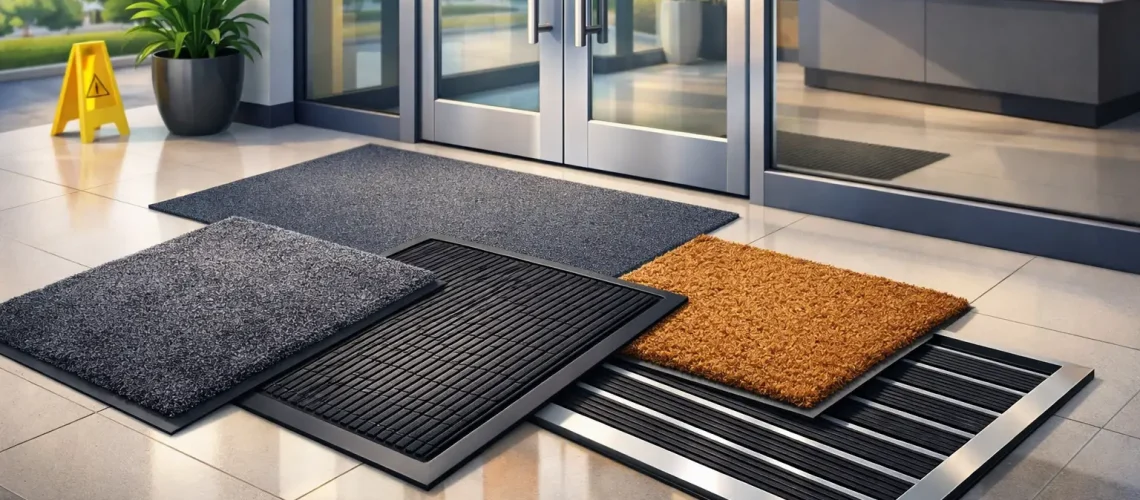
Nylon-faced mats are a common choice for indoor applications because they can present color well, handle printed logos clearly, and perform reliably in many commercial settings. They tend to work well when image quality and moisture retention both matter.
Rubber-backed scraper mats are often better suited for harsher entry points, especially where traction and debris removal are priorities. Some all-rubber or rubber-reinforced mats are built specifically for outdoor exposure and heavier wear.
Water-dam style mats are useful in places where rain and snow are regular concerns. Their borders and construction help contain moisture instead of letting it spread onto surrounding floors. That can make a real difference in reducing slip hazards and minimizing mop-up during bad weather.
There is no single best material for every facility. A retail storefront in Florida, a medical office in Ohio, and a school district in Colorado may all need different solutions based on climate, traffic, and cleaning routines.
Even a high-quality mat will underperform if it is undersized or poorly placed. One of the most common mistakes is choosing a mat based only on the door opening rather than the actual walking path.
People do not always enter in a straight line, and they rarely wipe their feet deliberately. The mat needs to sit where traffic naturally lands. In many entrances, wider coverage helps prevent people from stepping around it, and longer coverage improves dirt and moisture removal because each step does more work.
For larger entryways, multiple mats can be more effective than one small piece. An exterior scraper mat followed by an interior logo or water-retention mat creates a more complete system. That approach is especially useful in facilities that need both practical performance and a polished first impression.
Recessed mat wells can also change the decision. If the mat needs to sit flush with surrounding flooring, thickness and edge profile become part of the buying process. In those cases, it helps to work with a vendor that understands commercial applications rather than treating the product like a generic décor item.
Not every entrance needs a logo, but many do. If your front door is part of the customer experience, branded commercial entrance mats can do more than fill floor space. They reinforce identity while serving a practical purpose.
This tends to work best in reception areas, lobbies, showrooms, school entrances, church foyers, hospitality settings, and public-facing offices. A well-produced logo mat can make the space feel more established and intentional. It also helps tie together the entrance with other branding elements in the facility.
The trade-off is that logo clarity depends on the product line and construction. Some mats are built more for heavy scraping and weather resistance, while others are better for detailed logos and color presentation. If logo quality is a priority, it makes sense to confirm what level of detail the mat can reproduce before ordering.
That is one reason buyers often prefer a free proofing process. It removes guesswork and helps you confirm layout, color, and sizing before production starts.
The mat itself matters, but so does the buying process. Commercial buyers are often working under deadlines, budget constraints, and approval chains. They need accurate information, clear expectations, and quick answers.
A supplier should be able to explain which mat lines fit indoor versus outdoor use, what kind of logo reproduction is possible, how long production will take, and what shipping looks like. If the answer to every question is vague, that usually creates problems later.
Experience helps here. A specialist in branded and commercial matting can usually guide product selection faster than a general seller with a limited catalog. That is especially true when the order involves custom artwork, multiple locations, or a facility with different entry conditions.
For example, LogoFloorMats.com has built its business around this kind of purchase, with a broad range of commercial and logo mat options, free proofs, and a straightforward ordering process designed for organizations that want the job done quickly and correctly.
Price matters, but initial price should not be the only filter. A cheaper mat that needs replacement sooner, looks worn quickly, or fails to control moisture can become the more expensive option.
The better way to look at cost is through total use. A dependable mat helps reduce cleaning labor, protect floor surfaces, and support a safer entry. It also avoids the poor appearance that comes from curled edges, faded graphics, or mats that stop laying flat.
That does not mean every facility needs the highest-end option. It means the product should match the job. A low-traffic side entrance may not require a premium logo mat. A busy front lobby probably does.
If you are comparing products, ask the practical questions first. Where will it go, what will it need to stop, how many people will walk across it, and does branding matter in that location? Once those answers are clear, the right mat category usually becomes obvious.
The best commercial entrance mats do not call attention to themselves for the wrong reasons. They stay in place, do their job every day, and help your entrance look cleaner, safer, and more professional without adding friction to your operation. When you choose with performance in mind, the result is usually better than just a mat at the door. It is one less problem for your team to manage.